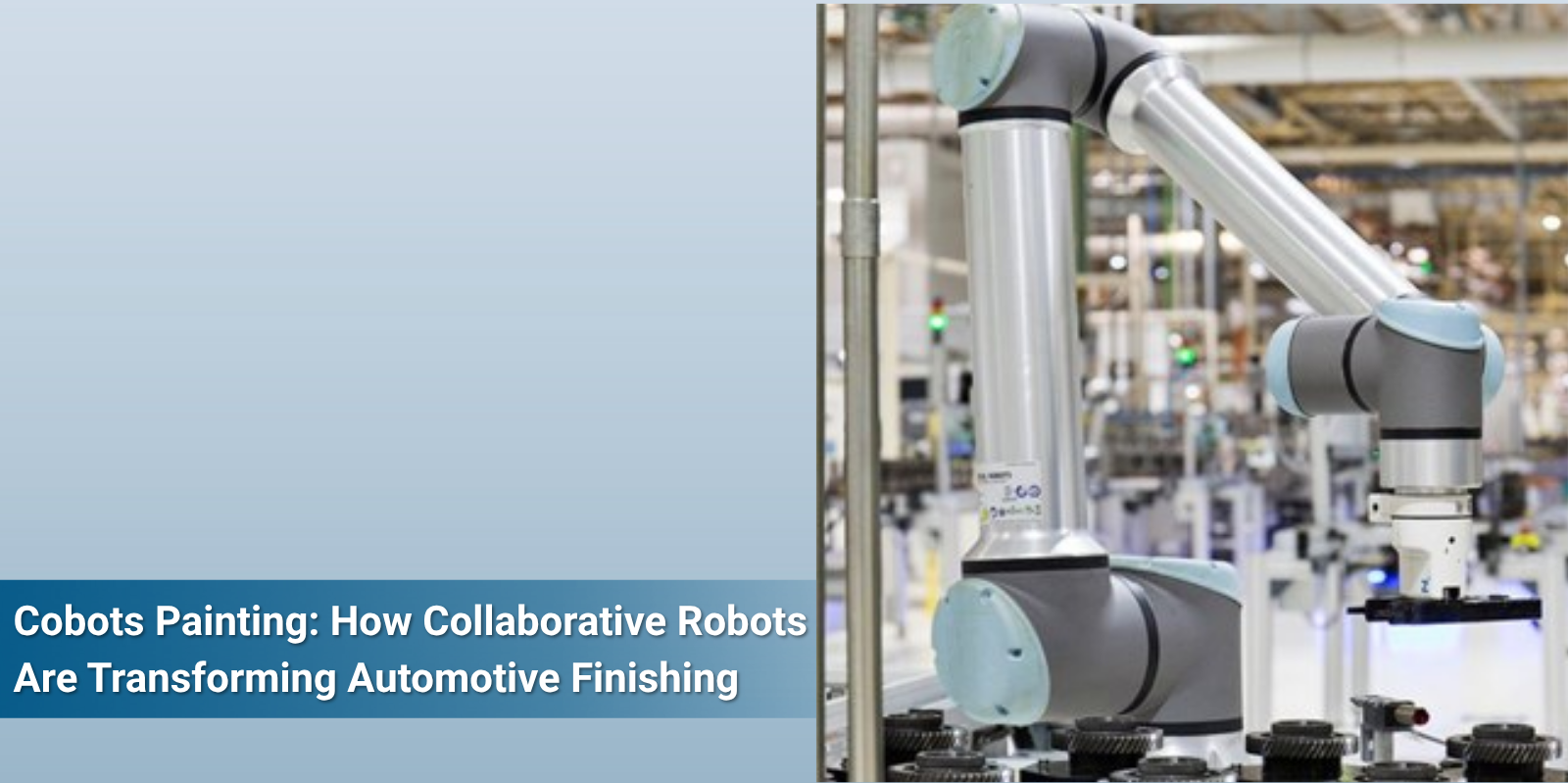
A smooth automotive finish starts with consistent paint coverage and the correct coating thickness. Even minor inconsistencies during this task can result in defects and rework. Cobot painting has therefore emerged as a practical automation approach for selected automotive finishing applications. It is a collaborative robot that offers flexibility in repetitive finishing tasks.
These cobot painting units are flexible enough for select applications. They can be programmed for different parts and moved between suitable workstations. They can be designed for collaborative operation in suitable applications, subject to application-specific risk assessment and the required safeguarding and paint-booth controls. Painting automation can be used in both high-production and small-batch operations where a consistent finish is required.
What is Cobot Painting?
A collaborative robot arm automates the application of paint. This includes paint, primer, coating and other finishing materials. The cobot can be integrated with a suitable spray gun, atomizer or other application equipment depending on the coating process.
A cobot can maintain a defined movement path, spray angle and travel speed for each programmed application.
Curious how cobots handle other tasks like dispensing and material handling? Explore Patvin’s cobot capabilities.
How Cobot Painting Works
In Cobot painting, a typical process involves five stages.
1. Part positioning
The component is positioned so that the cobot can access the required surfaces. Fixtures or positioning systems are also used to improve repeatability.
2. Path programming
The cobot is programmed according to the required painting process. This includes inputs like speed, distance, spray angle, etc.
3. Spray application
The cobot follows the programmed path while the application equipment controls material delivery. This helps maintain a consistent spray pattern and coverage across the programmed surface.
Cobots are typically paired with Patvin’s spray guns, atomizers and paint circulation systems for a complete finishing setup. Explore Patvin’s paint application systems.
4. Inspection and correction
The finished component can be checked for coverage, defects and other quality parameters. Vision systems can also be incorporated into suitable applications.
5. Repeat the Process
Once the process has been validated, the same programme can be repeated across production batches. Depending on the performance, parameters are adjusted.
This makes robotic finishing particularly valuable where manufacturers need repeatable results but also want flexibility.
Benefits of Cobot Painting in Manufacturing
Consistent finishing quality
Manual painting can vary with spray speed, distance and angle. A cobot follows the same programmed path each time, helping maintain a more consistent finish across batches.
Many of these consistency issues trace back to common paint application errors. It’s worth a look if manual spraying is still part of your process.
Reduced paint waste
Controlled spraying can reduce overspray and improve paint usage. A spray painting robot can maintain a consistent distance and movement, helping apply coating more efficiently.
Improved productivity
A cobot can handle repetitive painting tasks while operators focus on inspection, handling and other work. This can improve workflow and reduce the time spent on repetitive operations.
Better ergonomics
The repetitive movements involved in painting can be physically demanding, while exposure to certain hazards can create additional safety concerns. Automating tasks can reduce physical strain and operator exposure. The application still needs a proper safety assessment. A collaborative robot is not automatically safe for every painting setup.
Flexible production
Cobots can be reprogrammed for different parts and coating paths. This makes painting automation useful for manufacturers handling multiple products or smaller batches.
Space-saving
Cobots have a relatively compact footprint and can suit selected existing production areas where space is limited. They can also offer more flexibility than larger dedicated robotic cells.
Easier process changes
When a part or coating changes, the cobot programme can be updated for the new requirement. This can make production changes simpler and faster.
Cobot painting works best when paired with a stable paint supply. See how paint circulation systems support a flawless finish.
Cobot Painting vs Manual Spray Painting
Factor | Cobot Painting | Manual Spray Painting |
Consistency | Highly repeatable programmed movements | Depends on operator technique |
Spray path | Programmed and repeatable | Controlled manually |
Material usage | Can be optimised through controlled application | Can vary with operator technique |
Production speed | Consistent cycle times | May vary with operator and part |
Ergonomics | Reduces repetitive painting movements | Operator performs the full task |
Product changeover | Programme can be modified for suitable applications | Relies on operator training |
Quality control | Repeatable process parameters support consistency | Greater process variation is possible |
Best suited for | Repetitive, repeatable finishing tasks | Flexible manual work and complex tasks requiring direct judgement |
In many manufacturing environments, the approach is to combine automation with operator expertise.
Cobot Painting vs Industrial Robot Painting
Cobot painting and conventional industrial robotic painting use similar principles, but they are designed for different production requirements.
Factor | Cobot Painting | Industrial Robot Painting |
Typical strength | Flexibility and easier deployment | High speed and high-volume production |
Programming | Often designed for more accessible programming | Often requires specialised programming expertise |
Changeovers | Well suited to frequent changes | Better suited to stable, repetitive production |
Production volume | High-mix and selected low-to-medium volume applications | High-volume production |
Integration | Can suit existing production environments | Often requires more extensive integration |
Best use | Flexible finishing and selected repetitive tasks | High-speed, large-scale automated finishing |
Application determines the choice of technology. Conventional industrial robots work well for high-speed automotive paint shops. Cobots are valuable where flexibility, accessibility and easier deployment are more important.
Applications of Cobot Painting Across Industries
Robotic finishing can support multiple industries besides automotive finishes.
Automotive components
Cobots are useful in coating suitable components such as brackets, panels, trims, housings and other automotive parts. They can also be used for selected primer, basecoat or finishing applications.
Commercial vehicles and equipment
Manufacturers of trucks, buses, construction equipment and agricultural machinery often handle large components and multiple variants. A flexible coating robot can support suitable repetitive finishing operations.
Consumer durables
Appliance panels, enclosures and other manufactured surfaces can benefit from repeatable spray application. This can be particularly useful where appearance and coating consistency are important.
Metal products
Metal furniture, fabricated components, cabinets and enclosures can require consistent powder or liquid coating. Automation can reduce process variation across batches.
Plastics and moulded components
Plastic housings, covers and other moulded components may require decorative or protective coatings. A programmable spray painting robot can follow repeatable paths across suitable component geometries.
Cobots extend well beyond painting. See how they’re also transforming fluid handling and dispensing operations.
Aerospace and industrial products
Where the process, coating material and safety requirements permit, collaborative automation can support selected finishing operations in aerospace and industrial manufacturing.
The broader use of cobots reflects their ability to handle applications beyond traditional assembly. Patvin lists finishing, material removal, dispensing, welding, inspection, machine tending and material handling among potential cobot applications across industries.
How Patvin Helps Manufacturers Implement Cobot Painting
Patvin provides end-to-end assistance for painting automation. Depending on the application, the team assesses the technical and economic feasibility of introducing a cobot into the manufacturing process before developing a customised solution.
This can include:
- Process assessment: Understanding the existing painting or finishing operation and identifying suitable tasks for automation.
- Application study: Evaluating part geometry, production volume, cycle time, coating requirements and process constraints.
- Concept development: Developing a suitable cobot application around the customer’s production needs.
- Testing: Patvin can create a dummy environment that replicates aspects of the production setup, allowing the proposed application to be evaluated without disrupting the live production line.
- Integration: Connecting the collaborative robot with the relevant application equipment and production process.
- Training and support: Supporting customers through training, service, AMC and related automation requirements.
For larger installations, this typically rolls into a full turnkey project, from equipment supply to commissioning.
Conclusion
Cobot painting has a practical place in automotive finishing, particularly for repetitive jobs where maintaining the same spray path and finish can be difficult manually. It can also make sense when manufacturers need to handle different parts without committing to a large, fixed robotic cell.
The right setup will depend on the part, coating, production volume and existing process. Patvin works with manufacturers to assess these requirements and develop cobot solutions suited to their production environment, from painting and finishing to other repetitive industrial tasks.
FAQs
Cobot painting is the use of a collaborative robot to automate suitable painting or coating tasks. The cobot carries a spray gun, atomizer or other application tool and follows a programmed path to provide repeatable finishing.
A spray painting robot describes the robot-based application process, while a cobot is a specific type of robot designed for collaborative applications. A cobot can be integrated with spray equipment for suitable painting tasks, subject to the required safety assessment.
Yes. Cobots can support selected automotive painting and finishing applications, particularly where manufacturers need flexibility and repeatable movement. The exact suitability depends on the part, coating, production volume and safety requirements.
It can. Consistent spray paths, speed and application parameters can help control overspray and improve material utilisation. Actual savings depend on the coating process and system design.
For repetitive applications, robotic painting can provide greater consistency and repeatability. Manual painting may still be preferable for highly variable work or tasks that require continuous human judgement. In many factories, both approaches can complement each other.
Yes. Flexibility is one of the key reasons manufacturers consider collaborative robots. Cobots can be reprogrammed for suitable part variants, making them useful for certain high-mix and small-batch applications.
Cobots are designed with collaborative operation in mind, using features such as force sensing and safety functions. However, a cobot does not automatically make an entire painting application safe. The complete system must undergo an appropriate application-specific risk assessment.