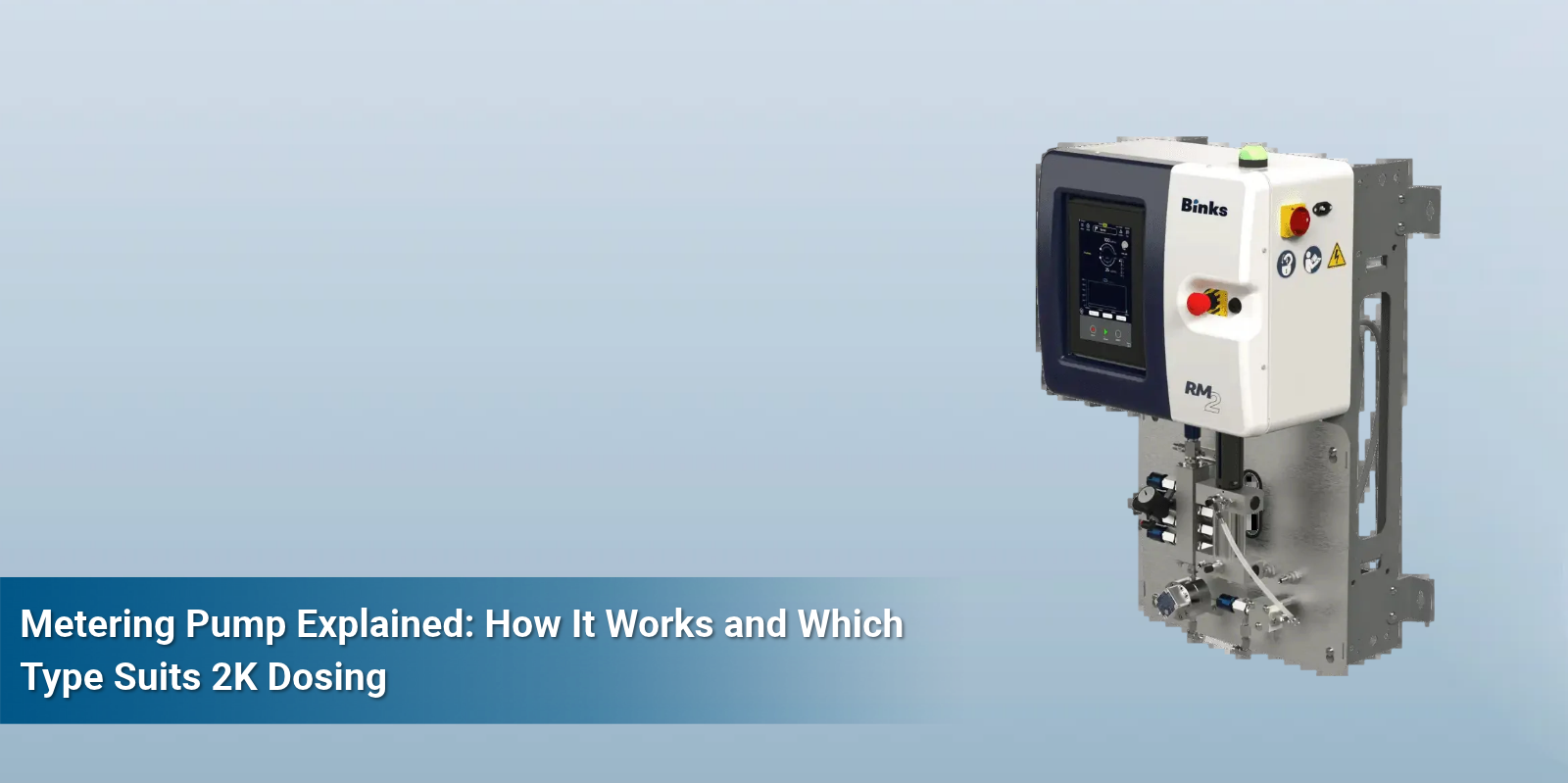
.Ever wondered how manufacturers get the exact proportions of each ingredient in paints, sealants, and adhesives? In many industrial applications, two materials are mixed in specific ratios. Only then can the product achieve the right strength and finish. For instance, a two-component (2k) coating combines base material and a hardener. If the ratio goes off, the coating will not cure properly.
This is why a metering pump, also called a dosing pump, is essential. It delivers a precise liquid volume for applications such as painting, adhesive dispensing, and sealant manufacturing. The right pump depends on the material viscosity, dosing, flow rate, and accuracy.
How Does a Metering Pump Work? (Dosing Pump Working Principle)
In industrial applications, a metering pump is critical. It delivers a set volume of liquid in a controlled manner. The pump design determines the mechanism, but the final aim is to deliver a set amount.
A dosing pump’s working cycle involves three steps:
Material intake:
The pump draws liquid from a supply tank or container.
Controlled transfer:
Its internal mechanism moves a measured quantity of material towards the outlet.
Material delivery:
The pump pushes the liquid into a dispensing line, mixing system, or application point.
In a reciprocating pump, a piston or diaphragm creates the movement needed to draw in and discharge the liquid. In a gear metering pump, rotating gears carry material through the pump towards the outlet.
For two-component materials, the pump must deliver both components at the right rate to maintain the required mix ratio. For example, a 2K system may need two parts of paint and one part of hardener. The pump must deliver these amounts in the correct ratio every time.
Factors such as temperature, material thickness, and pump wear can affect how much material flows through the system; therefore, the choice of pump matters. A metering pump should be selected around the process requirements rather than its maximum flow rate alone.
Types of Metering Dosing Pumps: Diaphragm, Piston, Peristaltic and Gear
Pump type | How it works | Best suited for | Key consideration |
Diaphragm metering pump | A flexible diaphragm moves to draw in and discharge liquid. | Chemical dosing, water treatment, and applications that need fluid isolation. | Check material compatibility, pressure and flow requirements. |
Piston metering pump | A moving piston draws in and pushes out a measured quantity of liquid. | Applications that need controlled delivery at suitable operating pressures. | Seal wear and compatibility with the process fluid require attention. |
Peristaltic pump | Rollers compress a flexible tube to move liquid through it. | Sensitive fluids, small-volume transfer and applications where the fluid contacts only the tubing. | Tubing compatibility and wear can affect performance. |
Gear metering pump | Intermeshing gears move material from the inlet to the outlet. | Viscous materials such as resins, adhesives, paints and sealants. | Material properties, clearances and operating conditions affect performance. |
One size fits all doesn’t work for metering pumps. Diaphragm pumps are common in chemical dosing. Piston pumps are used in controlled displacement, while peristaltic pumps can simplify fluid handling where tubing provides the main contact surface.
A gear metering pump uses rotating gears to deliver thick materials such as paints, resins and sealants at a controlled rate. For 2K dosing, the pump must suit both materials, as differences in thickness can affect delivery.
Gear Metering Pumps for Paints and Sealants: When They Make Sense
Paints, resins and sealants vary in thickness and flow behaviour. Gear metering pumps can handle many of these materials, which makes them useful in coating and adhesive sealants. However, the pump must suit the material’s properties and the production process.
A gear metering pump may suit applications where:
- Viscous materials: Paints, resins and sealants.
- Continuous delivery: A steady supply of material is required.
- Controlled output: Consistent flow is important.
- Automated dispensing: The pump must work with the dispensing system.
However, check for abrasive particles, chemical compatibility, and the risk of material curing inside the pump. The pump must suit both the material and the operating conditions.
Want to understand gear pumps in detail? Read our complete guide to gear metering pumps.
Why Does 2K Dosing Need Accurate Mix Ratio Control?
A 2K system combines two components to create the final product. An incorrect mix ratio can affect curing, strength, and finish, leading to material waste and rejected products.
Accurate dosing helps ensure:
- Consistent product quality: Delivers the required quantities in each cycle.
- Reduced material waste: Minimises rejected products and repeat applications.
- Reliable curing and performance: Maintains the specified mix ratio.
- Better process control: Coordinates material delivery with production requirements.
The right metering pump and control system must account for material properties and operating conditions to maintain the required ratio.
Fixed Ratio vs Variable Ratio Dosing: Which One Do You Need?
The right dosing arrangement depends on whether your application uses one set mix ratio or requires adjustments during production.
Factor | Fixed ratio dosing | Variable ratio dosing |
Mix ratio | Uses a set ratio for the application. | Allows the ratio to be adjusted within the system’s designed range. |
Production needs | Suits repeatable processes using one formulation. | Suits processes that require different formulations or controlled ratio changes. |
Control requirements | Can use a simpler control arrangement. | Needs suitable controls to coordinate the component feeds. |
Setup | Requires the correct ratio to be established and verified. | Requires a defined adjustment range and verification at each required setting. |
Key consideration | Confirm that the ratio remains stable at the required output. | Confirm that the system maintains accuracy throughout its operating range. |
Choose fixed ratio dosing when you always use the same materials and combination. It keeps the operation simple when the required ratio does not change.
Choose variable ratio dosing when the process needs different mix ratios for different materials or production requirements.
In both cases, the ratio alone does not guarantee a good result. The system must deliver the correct volume of each component at the required rate. Operators should also verify the ratio during commissioning and after relevant changes to the process.
When comparing systems, it is important to know whether the specified ratio is measured by volume or by weight. These are not interchangeable when the two components have different densities.
Not sure how 1K and 2K systems differ? Read our 1K vs 2K adhesive systems comparison.
Where Does Gear Metering Fit in 2K Dosing?
Gear metering pumps can feed thick materials into a 2K dispensing system. Each component travels through a separate pump before reaching the mixing stage.
The pump selection depends on material thickness, required flow rate, operating pressure and chemical compatibility. The control system must also coordinate both pumps to maintain the required ratio as production needs change.
Proper mixing and cleaning are equally important to prevent material from curing inside the equipment. For manufacturers in India, maintenance, spare parts and technical support should also factor into the selection.
Working with thick materials? Read how to choose a sealant system for high-viscosity materials.
How to Choose the Right Metering Pump for Your Application
Before selecting a metering pump, define what the process needs to achieve. A clear set of operating requirements makes it easier to compare suitable options.
- Check material viscosity
Identify the viscosity of each component at its expected operating temperature. Do not assume that two materials in the same 2K system will behave alike. Share the relevant material data with the equipment supplier.
- Define the required flow rate
Calculate the amount of each component needed per minute, hour or dispensing cycle. Consider both normal production and the minimum and maximum output the system must support.
- Confirm the mix ratio
Establish the specified ratio and whether it is based on volume or weight. The pump arrangement and controls must deliver the correct quantity of each component.
- Assess operating pressure
Account for the pressure required to move each material through the lines, valves, and mixing equipment. The selected pump must handle the actual operating conditions.
- Check material compatibility
Confirm that seals, pump bodies, and other wetted parts can withstand the chemicals in the formulation. Also assess whether fillers or abrasive particles could cause wear.
- Decide on the control method
Determine whether the application needs a fixed output, adjustable speed, or feedback-based control. The control arrangement should support the required dosing accuracy throughout the operating range.
- Plan cleaning and maintenance
Consider how the system will be cleaned between production runs. In 2K applications, residual material can cure inside the pump or lines if the cleaning procedure is unsuitable or delayed.
- Evaluate the complete system
Look beyond the pump’s specifications. Check the supply arrangement, dispensing equipment, mixing unit, safety features, and service requirements. A well-matched system is more useful than a pump selected on price or maximum flow alone.
Providing these details to the equipment supplier helps narrow the options and reduces the risk of selecting a pump that cannot meet the application’s needs.
Common Mistakes When Selecting a Metering Pump
- Choosing by flow rate alone: Check accuracy at your required operating rate, not just maximum capacity.
- Ignoring viscosity differences: Select a pump suited to each material’s thickness.
- Assuming all gear pumps suit viscous materials: Check material compatibility and resistance to wear.
- Overlooking ratio control: Ensure both pumps deliver material in the required ratio.
- Ignoring temperature changes: Account for changes in material thickness and flow.
- Skipping calibration: Check pump output and dosing accuracy regularly.
- Neglecting cleaning and maintenance: Prevent material build-up and curing inside the equipment.
Avoiding these mistakes starts with a clear understanding of the material and the production process. It also requires the pump, controls, and dispensing equipment to work as one system.
Wrong mixing ratios also cause problems in paint application. See the common paint application mistakes and how to avoid them.
Conclusion
Choosing the right metering pump depends on your material, flow rate, operating pressure, and dosing requirements. For 2K applications, accurate ratio control is essential to maintain product quality and reduce material waste. Evaluate these factors before selecting a pump for your production process.
Patvin offers Graco equipment and industrial fluid-handling solutions for manufacturing applications. Looking for a metering solution for paint, sealant, or 2K dosing? Contact Patvin to discuss your application requirements and identify suitable equipment for your production process.
FAQs
A metering pump is a pump designed to deliver a controlled quantity of liquid at a defined rate. Industries use it for applications where dosing accuracy and repeatability matter.
The terms are often used interchangeably. Both generally refer to pumps designed to deliver a controlled amount of liquid. The exact features depend on the pump design and application.
The choice depends on the materials, viscosity, required flow rate, pressure, and mix ratio. Gear metering pumps may suit viscous paints, resins and sealants, but the complete dosing system must be assessed before selection.
A gear metering pump uses rotating gears to move material from the inlet to the outlet. Its performance depends on the pump design, fluid properties, operating speed, and pressure conditions.
Yes, suitable gear metering pumps can handle many viscous materials, including certain paints, adhesives and sealants. However, the material's viscosity range, abrasive content, and chemical compatibility must be checked.
Accuracy can depend on pump design, calibration, viscosity, temperature, pressure, wear, and operating conditions. In 2K systems, the controls must also coordinate both component feeds to maintain the required ratio.
Fixed ratio dosing suits applications that use one consistent formulation. Variable ratio dosing suits processes that require controlled changes to the mix ratio. The choice depends on production requirements and the system's designed operating range.