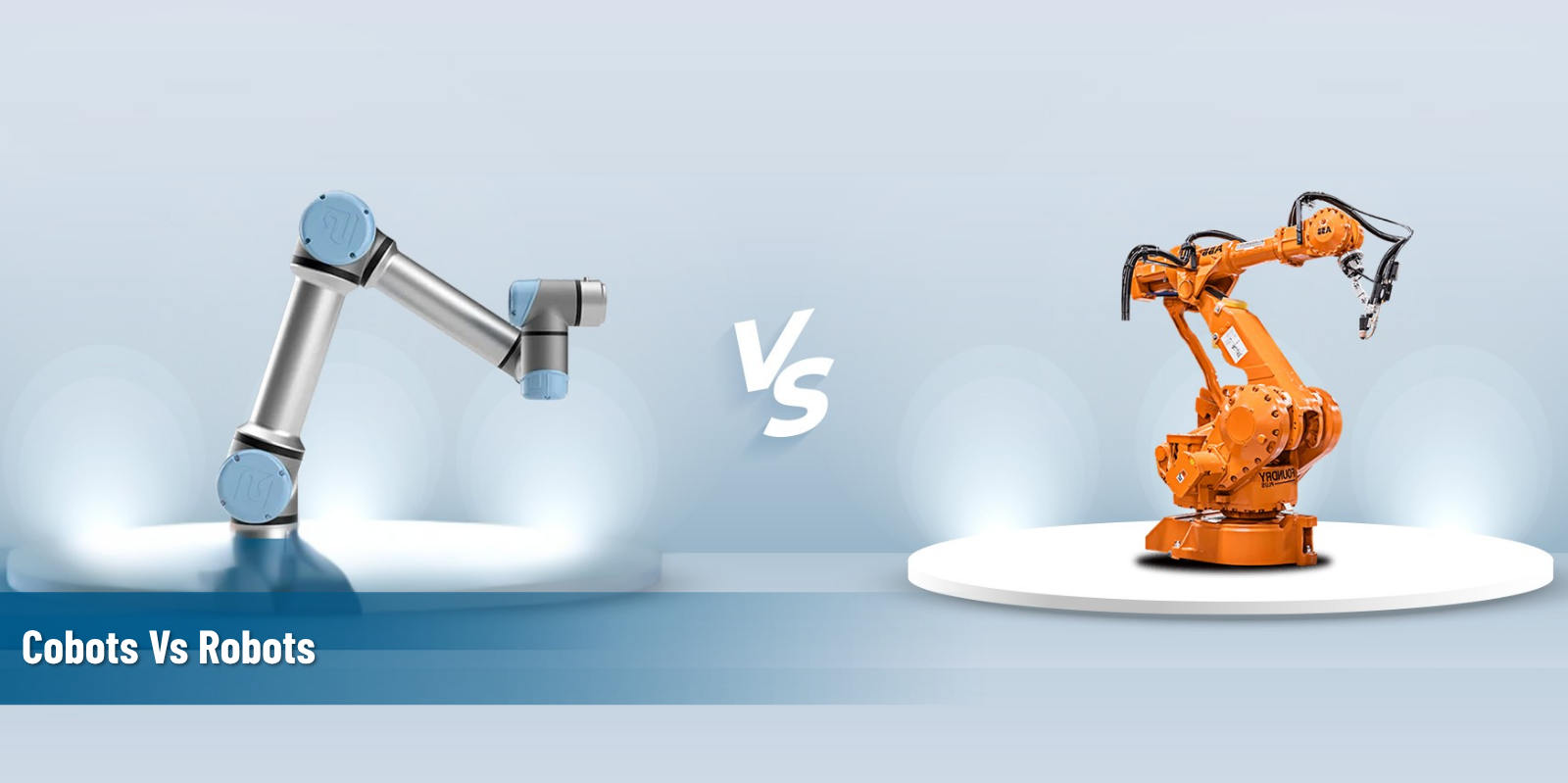
Technology today is about revolutionizing human resources by optimizing them, not replacing them, especially in manufacturing units. While the concept of robots in manufacturing units is not novel, it has seen a major overhaul. Today, manufacturers accept collaborative bot solutions to obtain more customization in processes. While industrial robots are generally pre-programmed and lack tailoring of settings, collaborative robots offer a greater level of customization while being safe with human interaction in the same operational setting. Let’s understand in detail:
Defining Cobots and Robots
Cobots
Cobots, otherwise called Industrial collaborative robotic systems, are specific kinds of robotic systems that are planned to be used in the same physical environment as people. They are made with aspects that include safety, flexibility, and product design in order to enhance their usage.
Most cobots have force and torque sensors for perceiving contact with people or objects and responding in safe ways. They are also small in structure and flexible in form; therefore, they are easy to move and reorganize for different uses. At present, cobots are applied in various operations such as assembly, picking and placing, machine tending, and quality inspection.
Robots
Industrial robots, for instance, are self-contained mechanisms used to execute operations on their own. They are designed to be deployed for tasks that are cyclical in nature, require high accuracy, and or present a certain amount of risks to human life.
Industrial robots are larger than cobots, faster, more powerful, and have greater capabilities in terms of payload and workspace. They are usually guarded by safety cages or barriers to prevent the human workers from coming close to possible risks. Robots are used in welding, painting, handling of material, packing, etc.
Key Differences Between Cobots and Robots
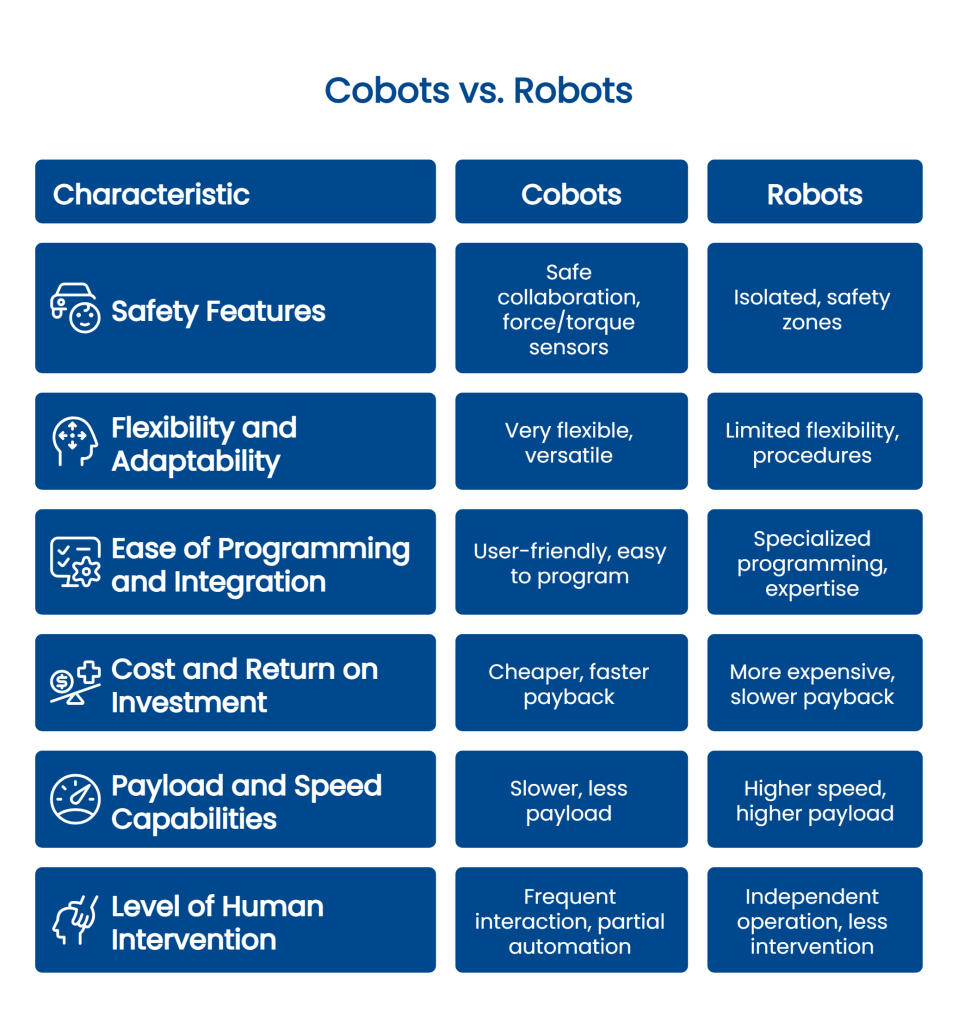
Let’s have a closer look at Cobots vs. robots:
| Factor | Cobots | Robots |
|---|---|---|
| Safety Features | Built for safe collaboration with humans; force and torque sensors, smooth contours | Isolated from people, with safety zones in between |
| Flexibility and Adaptability | Very flexible and versatile, enabling reprogramming of various tasks and jobs | Great limitations to flexibility of robots and their procedures |
| Ease of Programming and Integration | User-friendly and easy to program, even without extensive robotics experience | Require specialized programming languages and expertise |
| Cost and Return on Investment | Cheaper capital outlay, faster payback period, lower setup and training costs | Higher capital outlay, longer payback period |
| Payload and Speed Capabilities | Usually slower moving, less ability to carry heavy loads | Higher speed and payload, perfect for high-speed movements |
| Level of Human Intervention | Frequently partially automated; may need reprogramming, cleaning, or work alongside people | Once initialized and configured, can perform operations independently for longer duration |
Applications of Cobots and Industrial Robots
The cobots are suitable particularly for tasks that demand precision and frequent change of sequences and locations, such as
- Assembly
- Machine tending
- Quality inspection
Industrial Robots are well fitted in activities that require accuracy, speed, and the ability to carry heavy loads with little intervention from the operators.
Choosing Between Collaborative Cobots and Robots
Some of the considerations that can made when it comes to Cobots vs robots include;
- Nature of tasks to be performed
- Degree of interaction to be made between human and robot
- Need for precision and speed, and the available space
Here’s a quick overview of the benefits of these solutions
| Cobots | Robots |
| – Improved safety and reduced risk of injury | – High precision and speed |
| – Increased flexibility and adaptability | – Ability to perform repetitive and hazardous tasks |
| – Easy programming and integration | – Increased productivity and efficiency |
| – Cost-effective solution for small to medium-sized businesses | – Reduced labor costs |
Conclusion
Hence, cobots and robots are differentiated by their function and the requirements of the tasks to be completed. If you are searching for a robotic solution that has the capacity to provide high degrees of dexterity and adaptability to work alongside employees, a cobot could be a perfect option. At Patvin, there are both standard and customized Collaborative robots depending on your company’s requirements. Feel free to contact us today to know more.