TL;DR
Collaborative cobots help industries automate liquid dispensing, filling, and dosing processes. They help workers reduce errors, improve efficiency, and support smart manufacturing in industries such as automotive, pharma, food processing, and chemicals.
Introduction
Tired of endless manual inputs day in, day out for your fluid systems? As cobots in fluid handling become more common in manufacturing, industries are reducing manual errors, improving consistency, and making automation more flexible.
Issues in fluid systems become even more complex due to the processing layers. In some machines, liquid is expected to move, measure and be mixed in precise quantities before dispensing. Even the smallest variation can fully alter the end product quality and output. For example, in the paint industry, one small error can completely change the colour a client needs.
This is where cobots in fluid handling are starting to change how production lines are designed. Instead of replacing them, they work alongside existing systems and operators, taking over repeatable tasks.
In India, manufacturers in the automotive, chemicals, lubricants, and pharmaceuticals industries are increasingly adopting fluid handling automation. It helps reduce variability in processes that were earlier difficult to standardize.
This shift feels like it replaces people, but that’s not true. It is, in fact, about removing inconsistencies so that people can focus more on the work that needs their attention.
What Are Cobots? Understanding Collaborative Robots in Manufacturing
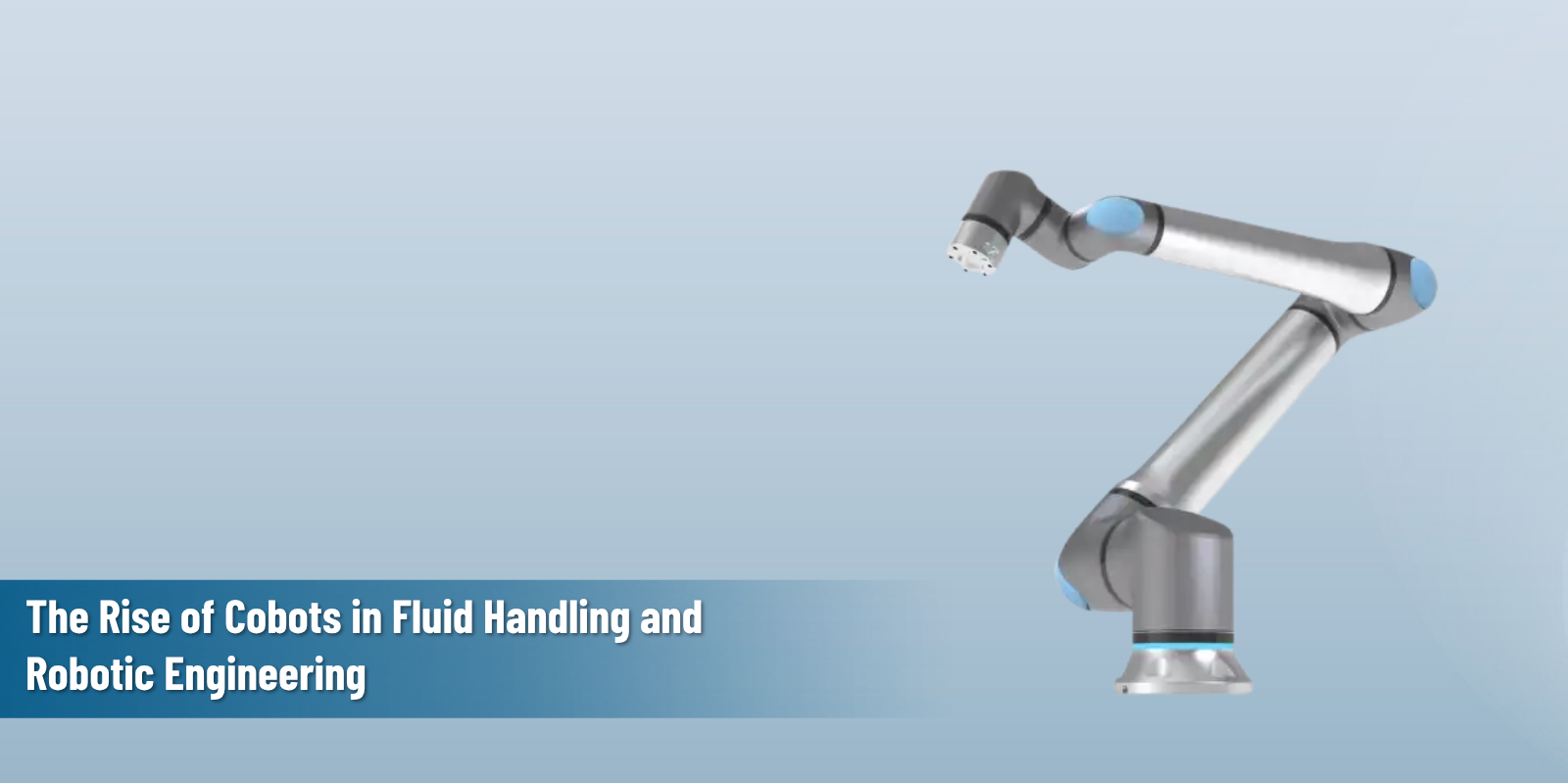
Cobots are collaborative robots designed to work in synergy with humans. They don’t work in isolation like traditional robots. In industrial automation, cobots usually take over repetitive tasks. Especially those that demand repetition and accuracy.
Cobots are equipped with sensors, force limiters, and smart programming. This enables safe interaction with human workers and leads to better overall output.
In robotic fluid handling systems, cobots manage fluid handling. It helps with dispensing, filling, transferring, and mixing in complex production systems. Each drop is measured correctly, which is important in industries where precision matters.
The best part is that the flexibility it delivers makes them suitable for small and medium factories that want automation without having to rebuild entire production lines.
Role of Cobots in Fluid Handling Systems
The role of cobots in fluid systems is to deliver precision and consistency. Traditional fluid transfer setups require either manual control or fixed automation. Both have their own flaws. We need systems like cobots. Wondering how cobots are used in fluid handling systems? They are used by programming them for repeatable tasks.
Cobots can:
- Dispense exact fluid volumes
- Handle multiple liquid types without contamination
- Adjust flow rates in real time
- Work continuously with minimal downtime
In robotic systems for liquid handling in industries, cobots reduce dependency on manual processes. You can expect faster speeds and fewer errors in sensitive operations. Ideal for chemical mixing or lubrication systems. They also integrate easily with sensors and IoT systems, allowing real time monitoring of flow, pressure, and quantity.
Key Applications of Cobots in Fluid Handling
Cobots are now used across multiple fluid based operations. Their flexibility makes them suitable for different industrial needs.
Common applications include:
- Adhesive dispensing in automotive assembly
- Chemical dosing in pharmaceutical production
- Paint and coating applications
- Food and beverage liquid filling
- Oil and grease dispensing in machinery
Table: Cobots in Fluid Handling Applications
Industry | Application Area | Cobots Role |
Automotive | Lubrication systems | Precise grease/oil dispensing |
Pharma | Liquid dosing | Controlled chemical measurement |
Food & Beverage | Filling & bottling | Hygienic liquid handling |
Manufacturing | Coating & adhesives | Even and consistent application |
Electronics | Thermal pastes | Micro level precision dispensing |
In cobots in lubrication systems, accuracy becomes most critical. Over lubrication can damage machines, while under lubrication can cause failure. Cobots maintain exact levels every time.
Benefits of Using Cobots in Fluid Handling
Cobots in fluid handling offer promising benefits, which is why their applications are growing, as they directly improve production outcomes.
Key benefits include:
- Higher precision in liquid measurement
- Reduced material waste
- Improved workplace safety
- Lower operational costs over time
- Consistent product quality
- Faster production cycles
Because cobots can work well in human robot collaboration, they improve monitoring and quality control and enhance processes. Cobots can be reprogrammed quickly, making them an excellent add on to your existing system. This helps factories switch between different fluid handling tasks without major downtime.
Many manufacturers today are also exploring the differences between cobots and industrial robots while planning more flexible automation systems.
Cobots vs Traditional Automation in Fluid Handling
There is a clear difference between cobots and traditional robotic systems. Both fall under industrial automation, but their use cases differ.
Comparison of Cobots and Traditional Robots
Factor | Cobots | Traditional Robots |
Workspace | Shared with humans | Isolated zones |
Setup time | Quick and flexible | Complex and time consuming |
Cost | Lower entry cost | High initial investment |
Flexibility | High (easy reprogramming) | Limited flexibility |
Safety | Built in safety features | Requires external safety systems |
Use case | Small to mid scale operations | Large scale repetitive tasks |
Cobots, rather than traditional robots, are preferred in manufacturing for their adaptability. They are ideal for industries that frequently change product lines or fluid types.
Challenges in Implementing Cobots in Fluid Handling
Even with strong benefits, the adoption of cobots has its own challenges.
Some common issues include:
- Initial training required for operators
- Integration with old machines and systems
- Calibration needs for different fluid types
- Safety compliance in mixed environments
- Limited awareness in smaller industries
In fluid handling automation, even the smallest calibration needs to be perfect. Small imperfections can also deliver inconsistent performance. A strong workflow design is essential for consistent output. Cobots work best when processes are clearly defined and standardized.
The Future of Cobots in Fluid Handling and Smart Manufacturing
The adoption of smart factories and digital systems demands the use of collaborative robots in manufacturing. In the coming years, cobots will become more intelligent. AI based learning to adjust fluid flow automatically based on real time conditions.
We will also see integration with sensors and cloud systems. This will improve tracking in robotic fluid handling systems, especially in regulated industries such as pharma and food processing.
In India, the rising demand for efficiency and quality control is increasing the adoption. Cobots will play a major role in this shift. We will also see more advanced robotic systems for liquid handling in industry, where cobots manage multiple production steps without human intervention.
As industries continue adopting smarter automation technologies, cobots are becoming an important part of modern manufacturing across different sectors.
Conclusion
An industry that depends on fluids can benefit most from cobots. They enable safe human collaboration, thus enhancing control over complex processes. The rise of cobots in fluid handling reflects a shift toward smarter and more efficient manufacturing systems.
As industrial automation evolves, Patvin helps manufacturers bring practical automation into fluid handling operations through cobots integration solutions. Cobots help reduce downtimes and improve overall performance while offloading repetitive tasks from humans. Their role in human robot collaboration will define the next phase of modern manufacturing.
FAQs
Cobots are used to dispense, mix, fill, and transfer liquids with high accuracy in industrial environments.
They improve consistency, reduce waste, and enable flexible programming for various liquid handling tasks.
Cobots are better suited to flexible, small to mid scale production setups, while traditional robots suit fixed, large scale operations.
They are used in machinery maintenance to apply precise amounts of grease or oil, preventing overuse or underuse.
Industries like automotive, pharma, food and beverage, chemicals, and electronics widely use these systems.
The biggest benefit is precision with flexibility, enabling consistent output and reducing operational errors.